Foundation Sprints
Short build cycles turn concepts into working demos before students lose momentum.

Build early. Learn fast. Solve real problems.
For 1st - 6th semester students
A foundation program for students who are still early in college but ready to stop waiting. Students learn by building small products, using AI tools, working in teams, and turning classroom theory into visible proof of capability.
4-6 wk
Semester rhythm
Peer
Learning model
Labs
Build format
Portfolio
Proof
Program OS
The page structure follows a project-based program pattern: clear outcomes, staged progression, public proof of work, feedback loops, and measurable readiness.
Short build cycles turn concepts into working demos before students lose momentum.
Students learn how to use AI as a thinking partner, debugging aid, research assistant, and build accelerator.
Students review each other's work, explain decisions, and build the confidence to defend their choices.
Each lab starts with a real-world friction point and ends with a useful prototype or technical artifact.
Visual Lab
Foundation Labs should feel like a workshop: small experiments, fast mistakes, visible progress, and peer energy.
Observe
Find one messy real problem.
Build
Turn it into a tiny working tool.
Review
Let peers break the logic.
Improve
Ship a cleaner second version.
Build Bench
Students learn by making small things work, then improving them in public.
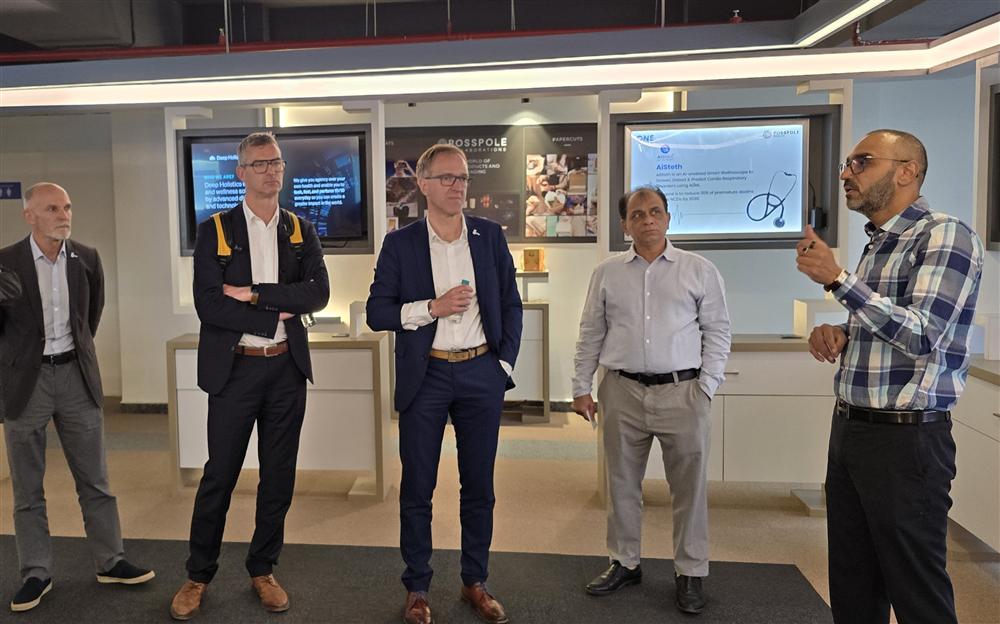
Peer Energy
Every lab has discussion, critique, and shared problem solving.
AI Tools
AI is treated as a builder workflow, not just a shortcut.
Journey
Each stage creates evidence: decisions made, products shipped, critique absorbed, and progress shown.
Map a real problem, user, system, or campus workflow.
Build the first simple version with guided tools and peer support.
Collect feedback, measure friction, and improve the build.
Present the project, reasoning, and learning evidence.
Curriculum Grid
Modules are framed by output, not lectures.
| Track | Focus | Output |
|---|---|---|
| Builder Thinking | Problem framing, user empathy, root-cause analysis | Problem brief |
| AI + Tools | Prompting, research, debugging, workflow automation | AI workflow log |
| Code + Systems | Web basics, APIs, data, simple architecture | Working mini-product |
| Communication | Demos, peer critique, writing, decision notes | Demo narrative |
Proof Stack
A compact portfolio that can be reviewed by mentors, founders, universities, and industry partners.
State Change
A simple comparison table to make the program philosophy clear at a glance.
Old Model
Learning waits for exams and semester-end marks.
Catalyst Model
Learning is proven through working prototypes and demo reviews.
Old Model
Students consume theory without seeing where it applies.
Catalyst Model
Every concept is tied to a problem, decision, and artifact.
Old Model
AI is treated as a shortcut or banned tool.
Catalyst Model
AI is used as a disciplined workflow that students must explain.
Old Model
Peer work is informal and inconsistent.
Catalyst Model
Peer critique becomes a repeatable part of the learning system.
Outcomes
The outcome cards are written as real capability changes rather than generic promises.
Students stop waiting for final year and begin building proof from the first half of college.
They learn to break problems into observable systems, constraints, hypotheses, and tests.
Strong performers graduate into tougher public build environments like the Global Builder Challenge.